


Eco-friendly carbon purification plant to reduce black smoke from brick kilns in Thakurgaon
Published:
২১ ডিসেম্বর ২০২৫, ১২:৩৪
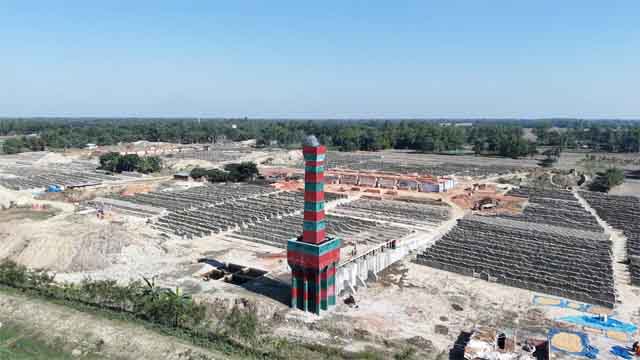
Black smoke and harmful gases from brick kilns have long been a major threat to the environment and public health. Gases like methane, carbon dioxide and nitrous oxide, mixed with the air, increase the temperature and damage the respiratory system, skin and crops. In such a reality, an eco-friendly carbon purification plant (CPT plant) has been launched for the first time in Thakurgaon to reduce environmental pollution.
Ariful Islam Jewel, the owner of M.A. Bricks-3 brick kiln in Thakurgaon, has converted his brick kiln to protect the balance of the environment and ensure the use of modern technology. The new technology has been introduced experimentally in this brick kiln located in Bakesher Hat area of Akcha Union of Sadar Upazila. On the one hand, environmental pollution is being reduced, and on the other hand, the owner of the kiln is also benefiting economically.
Local residents said that earlier, the surrounding area was often covered in smoke due to the black smoke emitted from the brick kiln. Children and the elderly used to have difficulty breathing, and the leaves of crops were covered in black. After the carbon purification plant was launched, that picture has changed a lot.
Abdul Haque, a farmer from Akcha Union, said that earlier, a black coating would fall on the leaves of rice, and it would be difficult to breathe while working in the field. Now, due to less smoke, the crops are better than before. Mostafizur Rahman, a farmer from the same area, said that earlier, potatoes and vegetables would be damaged, but now that problem is gone—this time, I hope the yield will be good.
Ariful Islam Jewel, about the carbon purification plant, said that this modern chimney works through eight chambers. The smoke coming out of the chimney first flows through an underground water spray channel. The carbon particles and harmful elements inside the smoke are trapped by the water spray. After purification, instead of smoke, it mixes into the atmosphere in the form of white and cool steam. This reduces both the heat and density of the smoke.
After visiting the brick kiln, environmental expert Dr. Murad Ahmed Faruk said that it is important to reduce carbon emissions to combat the effects of climate change. Brick kilns are a major source of air pollution in the country. If carbon purification plants can be used in this sector, it will be easier to control the temperature of the atmosphere. Although it is not possible to completely shut down the brick kiln industry, its harmful effects can be reduced to a large extent through modern technology. The initiative of M.A. Bricks-3 is timely and worth following.
Director of the Rangpur Divisional Environment Department Md. Nur Alam said that black smoke and harmful gases emitted from brick kilns are one of the main causes of air pollution. These gases not only destroy the balance of the environment but also pose a serious risk to public health. If the use of environmentally friendly technologies like carbon purification plants is increased, it will be possible to significantly reduce carbon emissions. This will keep the temperature of the atmosphere under control, while protecting agricultural land and public health. This initiative taken in Thakurgaon is a very positive and exemplary example.

Comment: