


Sixty Days, Sixty Steps
Bangladesh Toward Democratic Renewal and Prosperity
Published:
২৬ এপ্রিল ২০২৬, ১২:০৭

Sixty days have passed since the democratic government assumed office, and in that short span, it has taken sixty bold initiatives to reshape governance, restore public trust, and lay the foundation for a more just and prosperous Bangladesh. These early steps are not merely symbolic; they signal a determined break from the past and the beginning of a new political era.
Under the leadership of Prime Minister Tarique Rahman, the government is steering Bangladesh onto a path of new possibilities. This progress has not only been appreciated domestically and internationally, but is also a notable part of the global story of democratic renewal. One of the most encouraging aspects of this transformation is the introduction of a new culture of transparency and accountability in governance. A structured policy has been implemented to regularly present the performance reports of ministers, state ministers, and advisors before the public, helping to rebuild the fragile democratic framework of the country. The government’s primary objective is to present its relentless efforts transparently and establish a politics grounded in facts in the face of misinformation.
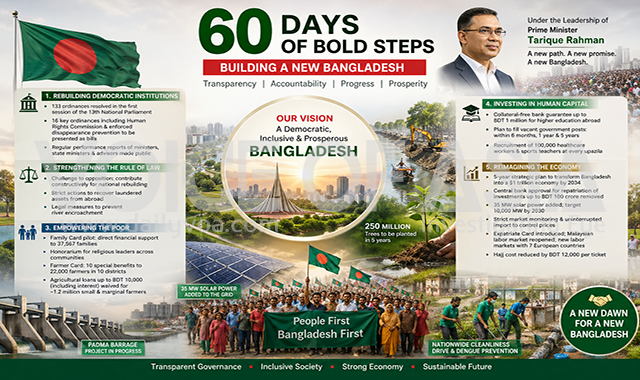
These sixty steps span five key areas: rebuilding democratic institutions, strengthening the rule of law, empowering the poor, investing in human capital, and reimagining the economy for long-term growth.
A positive shift in political culture has also been initiated. The government has challenged the opposition to move beyond obstruction and rhetoric, and instead contribute constructively to national rebuilding—recognizing that the people’s welfare must be placed above partisan tactics. The Prime Minister’s visionary leadership has also garnered international recognition; his inclusion in Time magazine's list of the world’s 100 most influential people stands as a global acknowledgment of Bangladesh’s long struggle to restore democracy.
Improving the quality of life for ordinary citizens remains a core priority of the government. Through the Family Card pilot, the government is channeling direct financial support to 37,567 families, demonstrating a new commitment to social protection and poverty-sensitive policymaking. Similarly, by introducing government honorariums for religious leaders across communities, the administration is signaling a stronger commitment to inclusive citizenship and interfaith harmony. A comprehensive 180-day action plan is being rapidly implemented to fulfill electoral commitments.
Through the “Farmer Card,” the administration is providing 10 special benefits to 22,000 farmers across 10 districts, ensuring the backbone of the economy is directly empowered. In a historic move, agricultural loans of up to BDT 10,000, including interest, have been waived for approximately 1.2 million small and marginal farmers. Environmental protection is also being prioritized through the nationwide excavation and re-excavation of 20,000 kilometers of rivers and canals, alongside an ambitious plan to plant 250 million trees over the next five years.
To uphold the rule of law and ensure state reform, 133 ordinances were resolved in the first session of the 13th National Parliament within a very short time. Among them, 16 significant ordinances—including those related to the Human Rights Commission and enforced disappearance prevention—are being prepared for presentation as bills after thorough review. Simultaneously, despite rising global fuel prices, energy security has been maintained through substantial subsidies and effective diplomacy. So far, 35 megawatts of solar power have been added to the national grid, with a clear target of producing 10,000 megawatts by 2030.
Beyond governance reforms, the administration is also addressing the economic anxieties of everyday citizens. Strict market monitoring and uninterrupted import of essential commodities are helping to stabilize prices, especially during Ramadan. At the same time, measures such as the Expatriate Card and the reopening of the Malaysian labor market signal a renewed focus on protecting the country’s migrant workforce. Efforts are also underway to establish new labor markets with seven European countries through bilateral agreements. Additionally, the cost of Hajj travel has been reduced by BDT 12,000 per ticket to ease the burden on pilgrims.
Looking ahead, a five-year strategic economic framework is being formulated to transform Bangladesh into a one-trillion-dollar economy by 2034. To encourage foreign investment, the previous requirement of central bank approval for repatriation of investments up to BDT 100 crore has been removed. Significant reforms have also been initiated in education and healthcare to invest in human capital. Students are now eligible for collateral-free bank guarantees of up to BDT 1 million for higher education abroad. Special plans have been adopted to fill vacant government positions within 6 months, 1 year, and 5 years. Furthermore, the government has announced the recruitment of 100,000 new healthcare workers to expand grassroots services and sports teachers at every upazila to support youth development.
The Prime Minister has set a rare example of personal and state-level austerity. He has chosen not to use the government residence “Jamuna,” instead residing in his own home, and has significantly reduced VVIP protocols. Under his direction, ministers have refrained from accepting duty-free vehicles and government plots—decisions that have been widely appreciated. In infrastructure and public health, progress is being made on the Padma Barrage project, nationwide cleanliness drives combat dengue, and strict legal measures are being introduced to prevent river encroachment. Strong legal actions are also being taken to identify and recover illicitly transferred assets from abroad.
The first sixty days of governance by the Bangladesh Nationalist Party have laid the foundation for a new Bangladesh—one that is more transparent, more inclusive, and more hopeful. The real test will be whether this early momentum can be sustained, but the people now have the right to believe that the long democratic winter is giving way to a new dawn.
H M Saif Ali Khan,
Joint Secretary (Information & Technology Affairs),
National Executive Committee, Bangladesh Nationalist Party (BNP)

Comment: